

Program
Designed for students drawn to understanding past peoples, the Archaeology Master of Arts (MA) program at the University of Saskatchewan equips you with advanced theoretical and methodological tools through field and course work.
Why choose USask for Archaeology?
- Opportunity to gain field and course work experience that strengthens theoretical and methodological skills.
- Work with expert faculty engaged in projects across the Northern Plains, Boreal Forest, Northwest Coast, Mongolia, and Arctic and Eastern Siberia.
Quick facts
-
Expected Length Thesis-based Course-based M.A. 2 years - Degree requirements
- Class delivery in-person
- Supervisor approval recommended before applying
- Deadlines and admission details below
Illuminators in exploring past worlds
This program supports your drive to investigate deep histories and contribute meaningfully to how we understand our shared human story.
Archaeology master's research areas
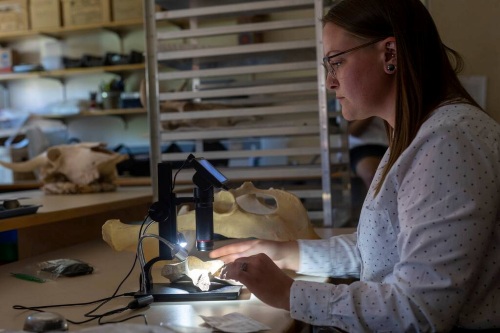
This thesis-based Archaeology Master’s program places particular importance on community-based research, particularly with Indigenous communities, and working with local archaeological societies to ensure our research aligns with community priorities. Our core research areas are:
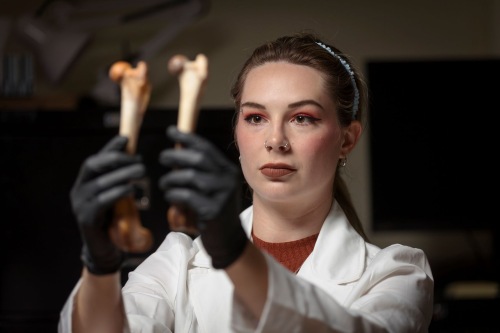
Bioarchaeology - with a focus on human remains from archaeological and other contexts, explore how social lives are embodied in skeletal and dental tissues and reconstruct past experiences (e.g., diet, activity, behaviour), health, and identities.
Environmental archaeology - investigate human-environment relationships and interaction from time immemorial through the recent past, employing a combination of palaeoethnobotanical and archaeological research methods.
Zooarchaeology - analyze faunal remains from archaeological sites to understand past human–animal relationships, including diet, subsistence, season of occupation, animal processing, domestication, and animal life histories.
Community-based archaeology - collaborate with present-day communities, with a strong focus on working with Indigenous Peoples, to ensure archaeological work aligns with community priorities, including efforts to locate unmarked graves at former residential schools.
Non-invasive archaeology – learn about and employ new technologies oriented toward non-invasive archaeological investigative techniques at archaeological sites and in the search for unmarked graves, including GIS-based research, geophysical analysis, ground penetrating radar, soil spectroscopy, quantitative analysis, computer modelling, photogrammetry, and drone-based applications.
Research supervisors
Before applying, we recommend contacting a potential supervisor whose research areas align with your interests. Share your academic background and research goals. If they are accepting students, they will instruct you to begin a formal application.
| Name | Research areas |
|---|---|
| Ancient Egyptian Archaeology, Egyptian Coffins, Ancient West Asia (Near Eastern) Archaeology, History of Women in Archaeology, Digital Games and Archaeology | |
| Bone aging, adaptation and disease 3D Imaging Synchrotron Science | |
| Bioarchaeology; Paleopathology; Dental Anthropology; Foragers; Pastoralists; Middle Holocene; Asia | |
| Stone Tools (lithics); Lithic Provenance; Novice Skill Acquisition; Gender and Agency; Digital Site Preservation; Archaeogeophysics | |
| Collaborative archaeology; Human-animal studies; Zooarchaeology; Canadian Prairies; Circumpolar North; ; ; | |
| Environmental archaeology; Community-based archaeology; Archaeology of Western Canada; Archaeobotany; Human Environmental Impact; Fur trade archaeology |
Tuition and funding
Funding
Graduate students at USask can receive funding from a variety of sources to support their graduate education.
Tuition and fees
Thesis or project-based master's program
Graduate students in a thesis or project-based program pay tuition three times a year for as long as they are enrolled in their program.
| Term | Canadian students | International students |
|---|---|---|
| September 1 - December 31, 2026 | ||
| January 1 - April 30, 2027 | ||
| May 1 - August 31, 2027 | ||
| Total per academic year |
Student fees
In addition to tuition above, students also pay fees for programs like health and dental insurance, a bus pass, and other campus services. The amount you need to pay depends on if you are taking classes full time or part time, and if you are on campus or not. The table below assumes you are on campus full-time.
| Fall 2026 | Winter 2027 | Spring 2027 | Summer 2027 | |
|---|---|---|---|---|
| Student fees | $617.36 CAD | $854.96 CAD | $46.75 CAD | $46.75 CAD |
Tuition is typically billed and due in instalments, four times per year. Tuition information is accurate for the current academic year and does not include student fees. For detailed tuition and fees information, visit the official tuition website.
Admission requirements
Master of Arts (M.A.)
- Language Proficiency Requirements: Proof of English proficiency may be required for international applicants and for applicants whose first language is not English.
- a cumulative weighted average of at least a 70% (USask grade system equivalent) in the last two years of study (i.e. 60 credit units)
- a four-year honours degree, or equivalent, from a recognized college or university in archaeology or anthropology, or a related discipline
- a course in archaeological method and theory
- substantial course work in the area of declared research interest
Students with Honours degrees or equivalent in other related disciplines are encouraged to apply, but they may be required to do qualifying course work.
Application process and deadlines
Deadlines and important dates
| Start Term | Domestic Deadline | International Deadline |
|
Fall |
January 15 | January 15 |
Late applications may be considered but most awards are made in February and March.
Submit an online application
International students - Master's and doctoral students applying for a study permit do not need a Provincial Attestation Letter (PAL). Certificate and Postgraduate Diploma students, as well as Visiting Research students studying over six months, still need a PAL. Review federal international study permit policies before you apply.
Before beginning your online application, be sure that you have carefully reviewed all program information and admission requirements on this page.
During the application, you'll be asked for:
- Personal information such as your name, address, etc.
- Contact information of your three referees
- For your letters of recommendation, two of your referees must be academic contacts, and the third may be academic or professional
- Your complete academic history from all previous post-secondary institutions
The application takes about 30 minutes to complete. You may save your application and return to it later.
At the end of the application, you will need to pay a non-refundable application fee: $125 for domestic students and $145 for international students. Your application will not be processed until payment is received.
Submit required documents
Once you've submitted your online application, you will have access to upload your required documents, and provide the contact information for your references. To do this, go to the "Supplemental Items & Documents" tab in your application.
Preliminary Statement of Marks
- Once you have submitted your application for admission and paid the application fee, you will be required to upload unofficial PDF copies of your academic transcript(s) from each post-secondary institution attended. This requirement will appear as Preliminary Statement of Marks or Additional Prelim. Statement under admission requirements on your Application Summary when you check your application status.
- The uploaded transcript can be an unofficial copy of the transcript issued by the university or college and must include a grading key/legend.
- All pages of a transcript must be uploaded as a single PDF document.
- Uploaded transcripts will be considered unofficial or preliminary. Official copies of your transcripts will be required only for applicants offered admission. This requirement will appear as Post-secondary Transcript under admission requirements on your Application Summary when you check your application status.
- Transcripts in languages other than English must be accompanied by a certified translation.
For students who are required to provide proof of English proficiency:
- Completing a relevant test with the appropriate score is required before the application deadline.
- Tests are valid for 24 months after the testing date and must be valid at the beginning of the student's first term of registration in the graduate program.
- Applicants will be required to upload a PDF copy of any required language test score. Uploaded test scores will be considered unofficial or preliminary.
You may be required to submit the following documents:
- A Research Statement, which should be two to three pages in length and:
- indicate the area of specialization within Archaeology in which you intend to study (see departmental website) and with whom you wish to work and why
- identification of a possible research problem and initial outline of the methodology required to conduct the research. Indicate why the topic is important to the field of study
- background experience and interests that will contribute to your proposed research orientation
- A curriculum vitae or resume
- A Writing Sample: Please choose essays or terms papers (two in number) which have substantial arguments or other critical content, preferably from your archaeology courses. Original copies with the instructor's comments and grading would be appreciated, if possible. If you have published a paper, that would be a very suitable submission in place of one of the term papers.
Contact
Department of Anthropology
55 Campus Drive
University of Saskatchewan
Saskatoon, SK S7N 5B1
Graduate Chair
Tatiana Nomokonova
Email: tatiana.nomokonova@usask.ca
Graduate Administrator
Denise Huynh
Email: archanth.grad@usask.ca
- Department of Anthropology
Learn more about the academic unit offering this program - Program and Course Catalogue
To view official admission and program requirements