

Program
The Mathematics graduate programs at the University of Saskatchewan offer thesis-based training in a department with active research across pure, applied, and discrete mathematics. Whether your work is motivated by deep structural questions or by problems arising in the sciences and engineering, you will carry out original research under close faculty supervision in a collaborative, research-intensive environment.
Why choose USask for Mathematics?
- Study at a U15 research-intensive university with internationally-recognized faculty and strong cross-disciplinary collaborations, giving you access to a vibrant research environment.
- Benefit from a supportive graduate community with personalized supervision, advanced coursework, and mentorship, helping you develop in-demand skills across multiple sectors.
Quick facts
-
Expected length Thesis-based Course-based M.Sc. 2 years Ph.D. 4 years - Degree requirements
- Class delivery in-person
- Supervisor approval not required to apply
- Deadlines and admission details below
Investigators of structure and complexity
Join a graduate community advancing mathematical theory and applications—from algebraic structures and geometry to modeling, computation, and data-informed methods.
Mathematics master's and Ph.D. research areas
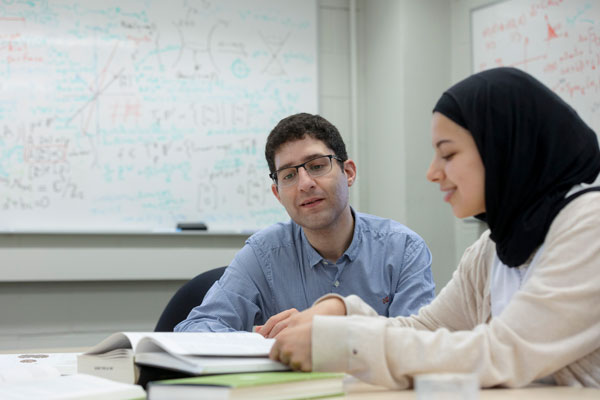
Graduate students in Mathematics work in a highly collaborative department that integrates foundational theory, computation, modeling, and interdisciplinary applications. Research spans domestic and global challenges in the mathematical sciences, and students develop rigorous problem-solving, research communication, and technical depth through supervised, thesis-based study.
The Department of Mathematics and Statistics is home to expert faculty who wish to work directly with graduate students on cutting-edge research in the mathematical sciences. We currently offer three specializations within our Mathematics degree programs:
- Pure Mathematics
- Applied Mathematics
- Discrete Mathematics
Research supervisors
Although you do not need to find or contact a potential supervisor before applying, you may reach out to express your interest in their research and ask about possible availability. If you are admitted, a supervisor will be assigned based on both faculty research needs and the interests you outline in your application, and you are welcome to list any faculty whose work aligns with your own. The following list shows our current faculty, their expertise, and the research areas they may supervise:
| Name | Research areas |
|---|---|
| Hybrid Dynamical Systems; Disease Models; Control Theory; Ordinary Differential quations (DEs) ; Delay DEs; Stochastic DEs | |
| Discrete Optimization; Combinatorics; Graph Theory; Mathematics Education | |
| Trustworthy AI; Statistical Geometry; Experimental Design; Causal Inference; Social Networks | |
| Mathematics Education | |
| Bayesian & MCMC methods; Biostatistics; Changepoint analysis; Computational statistics; Joint modeling; Survival & event-history analysis | |
| Statistical Machine Learning ; Model Diagnostics and Comparison; Statistical Learning for Bioscience; Parkinson and Alzheimer Diseases; | |
| Errors-in-variables Modeling; Computational Statistics; Mathematical and Statistical Biology; Spatial, Temporal and Longitudinal Data Analysis; Psychometric Methodology | |
| Algebraic geometry; Topology; Representation theory; Mathematical physics; Quantum computing; Quantum matter; Quantum information; Quantum mathematics | |
| Non-commutative harmonic analysis; Intersection of harmonic analysis and functional analysis; Investigating properties of Banach algebras related to the locally compact groups, particularly group algebras, Fourier algebras, group C*-algebras and group von Neumann algebras and/or their connection to the unitary representations of locally compact group; Operator space theory and its application in non-cummutative harmonic analysis | |
| Mathematical modelling ; Symmetry Methods and Exact Solutions of Nonlinear Models; Symbolic and Numerical Scientific Computation; Nonlinear Waves; Novel Materials; Biological Applications; Complex Fluid and Plasma Flows | |
| Statistical Mechanics; Computer Simulation; Combinatorics; Bioinformatics; Models of polymers | |
| Quantum Harmonic Analysis; Foundational principles and mathematical techniques for signal analysis; Applicable aspects of the Analytic Number Theory; Complex Systems and complex dynamic behavior ; Consequences of the nascent quantum technologies; Cryptography | |
| Numerical analysis; Scientific computing and software; High-performance computing; Optimization; Industrial mathematics and problem solving | |
| Applied probability; Queueing theory; Queueing networks; Markov chains | |
| Integrable systems; Mathematical physics; Lie theory; Inverse problems; Differential equations | |
| Pure Mathematics; Mathematical Analysis ; Functional Analysis ; Free Probability; Probability | |
| Representation theory ; Quantum groups; Quantum symmetric pairs ; Noncommutative algebra ; Infinite-dimensional Lie algebras ; | |
Please note that there are faculty in other units that may be able to supervise M.Sc. or Ph.D. dissertations in Mathematics. Such arrangements will be approved on a case-by-case basis.
Tuition and funding
Funding
We strive to offer financial support to the majority of our graduate students in eligible programs. In the course of their application and admission, students are advised about the possibility of financial support and particular funding opportunities.
Financial support for graduate students is normally offered in the form of Graduate Teaching Fellowships (at least $21,000 CAD for M.Sc. and $25,000 CAD for Ph.D.). The department automatically considers all eligible applicants for this funding.
Applicants who are successfully admitted to the program are also encouraged (and in some cases required) to apply for external funding, where eligible.
Graduate students at USask can receive funding from a variety of sources to support their graduate education.
Tuition and fees
Thesis or project-based master's program
Students in thesis and project-based master's programs are assessed tuition three times a year for as long as they are enrolled in their program.
| Term | Canadian students | International students |
|---|---|---|
| September 1 - December 31, 2026 | ||
| January 1 - April 30, 2027 | ||
| May 1 - August 31, 2027 | ||
| Total per academic year |
Student fees
In addition to tuition above, students also pay fees for programs like health and dental insurance, a bus pass, and other campus services. The amount you need to pay depends on if you are taking classes full time or part time, and if you are on campus or not. The table below assumes you are on campus full-time.
| Fall 2026 | Winter 2027 | Spring 2027 | Summer 2027 | |
|---|---|---|---|---|
| Student fees | $617.36 CAD | $854.96 CAD | $46.75 CAD | $46.75 CAD |
Tuition is typically billed and due in instalments, four times per year. Tuition information is accurate for the current academic year and does not include student fees. For detailed tuition and fees information, visit the official tuition website.
Doctoral program
Doctoral students are assessed tuition three times a year for as long as they are enrolled in their program. Both international and domestic PhD students pay the same rate.
| Term | |
|---|---|
| September 1 - December 31, 2026 | $1,879.00 CAD |
| January 1 - April 30, 2027 | $1,879.00 CAD |
| May 1 - August 31, 2027 | $1,879.00 CAD |
| Total per academic year | $5,637.00 CAD |
Student fees
In addition to tuition above, students also pay fees for programs like health and dental insurance, a bus pass, and other campus services. The amount you need to pay depends on if you are taking classes full time or part time, and if you are on campus or not. The table below assumes you are on campus full-time.
| Fall 2026 | Winter 2027 | Spring 2027 | Summer 2027 | |
|---|---|---|---|---|
| Student fees | $617.36 CAD | $854.96 CAD | $46.75 CAD | $46.75 CAD |
Tuition is typically billed and due in instalments, four times per year. Tuition information is accurate for the current academic year and does not include student fees. For detailed tuition and fees information, visit the official tuition website.
Admission requirements
- A cumulative weighted average of at least 70% (USask grade system equivalent) in the last two years of study (i.e. 60 credit units)
- A four-year honors degree, or equivalent, from a recognized college or university in an academic discipline relevant to the proposed field of study
- Language Proficiency Requirements: Proof of English proficiency may be required for international applicants and for applicants whose first language is not English
- A master's degree, or equivalent, from a recognized university in an academic discipline relevant to the proposed field of study; under no circumstances may a prospective student holding a bachelor's degree be admitted directly into a Ph.D. program
- A cumulative weighted average of at least 70% (USask grade system equivalent) in the last two years of study (i.e. coursework required in master's program).
- Language Proficiency Requirements: Proof of English proficiency may be required for international applicants and for applicants whose first language is not English
Admission is competitive, and meeting the minimum requirements does not guarantee admission or funding. Because resources and funding are shared across the Department of Mathematics and Statistics, admission decisions are made by the graduate committee in consultation with the department to ensure an equitable and effective use of available resources.
Application process and deadlines
Deadlines and important dates
| Start term | Application deadline |
|---|---|
| Fall term | December 15 |
Submit an online application
International students - Master's and doctoral students applying for a study permit do not need a Provincial Attestation Letter (PAL). Certificate and Postgraduate Diploma students, as well as Visiting Research students studying over six months, still need a PAL. Review federal international study permit policies before you apply.
Before beginning your online application, be sure that you have carefully reviewed all program information and admission requirements on this page.
During the application, you'll be asked for:
- Personal information such as your name, address, etc.
- Contact information of your three referees
- For your letters of recommendation, two of your referees must be academic contacts, and the third may be academic or professional
- Your complete academic history from all previous post-secondary institutions
The application takes about 30 minutes to complete. You may save your application and return to it later.
At the end of the application, you will need to pay a non-refundable application fee: $125 for domestic students and $145 for international students. Your application will not be processed until payment is received.
Submit required documents
Once you've submitted your online application, you will have access to upload your required documents, and provide the contact information for your references. To do this, go to the "Supplemental Items & Documents" tab in your application.
Preliminary Statement of Marks
- Once you have submitted your application for admission and paid the application fee, you will be required to upload unofficial PDF copies of your academic transcript(s) from each post-secondary institution attended. This requirement will appear as Preliminary Statement of Marks or Additional Prelim. Statement under admission requirements on your Application Summary when you check your application status.
- The uploaded transcript can be an unofficial copy of the transcript issued by the university or college and must include a grading key/legend.
- All pages of a transcript must be uploaded as a single PDF document.
- Uploaded transcripts will be considered unofficial or preliminary. Official copies of your transcripts will be required only for applicants offered admission. This requirement will appear as Post-secondary Transcript under admission requirements on your Application Summary when you check your application status.
- Transcripts in languages other than English must be accompanied by a certified translation.
For students who are required to provide proof of English proficiency:
- Completing a relevant test with the appropriate score is required before the application deadline.
- Tests are valid for 24 months after the testing date and must be valid at the beginning of the student's first term of registration in the graduate program.
- Applicants will be required to upload a PDF copy of any required language test score. Uploaded test scores will be considered unofficial or preliminary.
You may be required to submit the following documents:
- A research statement including a detailed description of your research interest(s). The Graduate Committee will carefully read this document to help ascertain your suitability for the intended graduate program and your fit with potential supervisors' research areas.
Contact

Department of Mathematics and Statistics
Room 142 McLean Hall
106 Wiggins Road
University of Saskatchewan
Saskatoon, SK S7N 5E6
Graduate Chair
Dr. Alexey Shevyakov
Application Admin Support
Anna McKenzie
Email: asg.gradapplications@usask.ca
Program Admin Support
Nadine Penner
Email: asg.graduateprograms@usask.ca
- Department of Mathematics & Statistics
Learn more about the academic unit offering this program - Program and Course Catalogue
To view official admission and program requirements